We develop optoelectronic devices based on wide band-gap semiconductors, and incorporate them into MEMS and Microfluidic systems.
The work spans materials growth and characterization, as well as device development and testing.
Welcome to the Research page of Anirban Bhattacharyya,


New publication..
AIP Advances 11, 085109 (2021);
Research Facilities
Our work is carried at two locations..

Institute of Radio Physics and Electronics,
University of Calcutta

Center for Research in Nanoscience and Nanotechnology, University of Calcutta
News
Arpita Das [PhD certificate awarded]
October 3, 2024
Wavelength-switchable UV LEDs [Paper published in Optics Letters]
2023 I <link>
Arpita Das [PhD Thesis submission].
June. 21 |
UV LEDs [Paper published in Journal of Electronic Materials]
March 21 | <link>
Silicon MicroCuvette [Paper published in IEEE Journal of MEMS]
Jan 21 | <link>
Alakananda Das [PhD Thesis submission].
January. 21 |
Chirantan Singha [Ph D Thesis submission].
Sept. 20 |
Sayantani Sen [Ph. D. Thesis submission].
Aug. 20|

Targets

Facilities
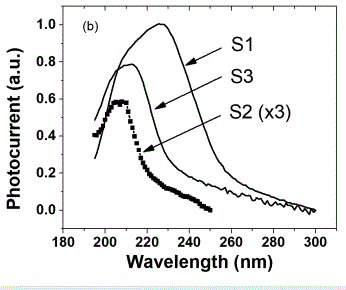
Water-borne diseases due to the presence of pathogenic microorganisms can be eradicated using the germicidal properties of ultraviolet light. However, the current systems based on mercury lamps are difficult to operate at off-grid remote locations, as well as during disaster times. We are working on the development of efficient ultraviolet light emitting diodes as well as battery-powered portable water purification systems based on them. We are also working on the development of ultraviolet photo-detectors based on thin films and nanowire arrays based on both the III-Nitride and the Zn(Mg,Al)O material systems.
We are also part of the push towards the development of lab-on-chip systems. Our efforts are directed towards the integration of optical sensor systems, typically fluorescence and absorption measurements, into LOC. Our goal is to develop a low-cost broad-based platform that can be used not only in pathology and diagnostics, but also in the chemical industry, agriculture, horticulture, and in environmental monitoring.
The microelectronics laboratory, at the Institute of Radio Physics and Electronics, University of Calcutta was initially developed in the 1990s, and has been thoroughly upgraded over the last decade. There are facilities for semiconductor device fabrication steps such as photolithography, oxidation, chemical vapor deposition, metallization. There are also extensive facilities for as well as for materials characterization such as Hall effect, photoluminescence, absorption spectroscopy, as well testing of devices at the wafer level and after wire bonding.
The Center for Research in Nanoscience and Nanotechnology is a fully functional state-of-the-art facility housing Molecular Beam Epitaxy systems, optical and electron-beam lithography (FESEM, TEM) as well as other characterization systems, all housed within a clean room. The details can be found at https://www.crnncu.org/
Our work is carried out at both facilities. We also collaborate with various universities and institutes for characterization of our samples and device.

Funding

Research Areas
Our work is funded through a number of government agencies through extra mural projects. Work on ultraviolet light emitting diodes was funded by MEITY (formerly DIT) Govt. on India, and through the Office of the PSA, Govt. of India. Work on Ultraviolet photodetectors has been funded by startup funds received from CRNN CU, and later from SERB, Govt. of India. We have also received support from CARS DRDO for epitaxial thin silicon films grown by MBE. The microfluidics work as been supported by the Govt. of West Bengal, Department of Science and Technology. We have also received support from DST under the BRICS program.
Some of the equipment at the microelectronics laboratory was procured through funds received through the Center of Advanced Studies (CAS) and UGC-NRCPS programs at the Institute of Radio Physics and Electronics. Support was also received from the TEQIP program, University of Calcutta.
We are currently working on the following areas:
A thrust area is the growth of III-Nitride materials, especially high Al-content AlGaN alloys by Plasma assisted Molecular beam epitaxy. We are working on both thin films as well as vertical nanowire arrays with embedded quantum wells and quantum dots. This work is directed toward the development of UV-A, UV-B and UV-C light emitting diodes and wavelength specific photo-detectors .
We are also looking into the growth of ZnO and Zn(Mg,Al)O materials in the thin film and nanowire form using sol-gel and vapor-liquid-solid processes respectively. These materials are incorporated into UV detectors as well as gas and vapor sensors.
Another thrust area is the use of silicon micro-machining and soft lithography techniques for the development of LoC components, micro-needles, micro-channels and micro-reactors.